

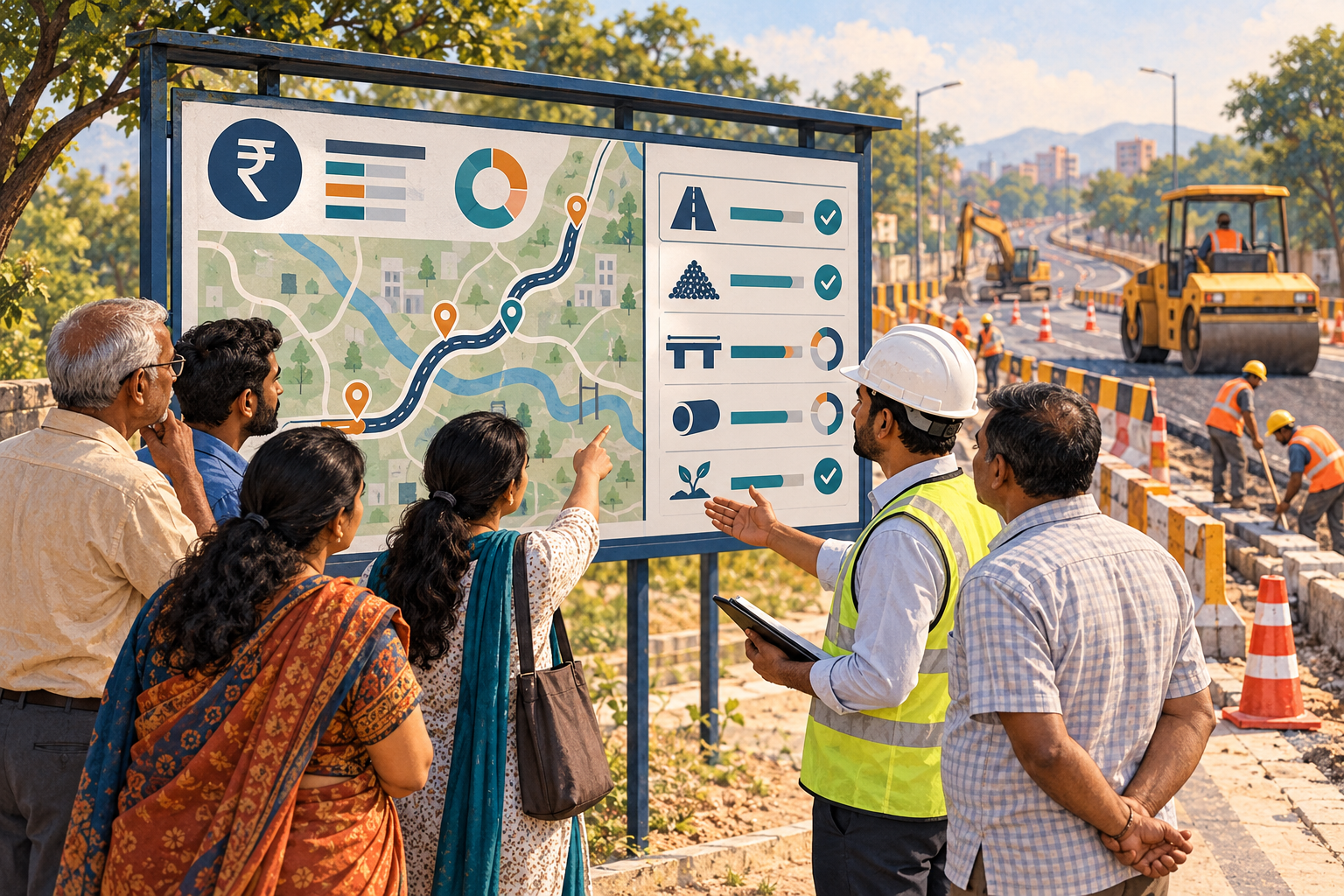
A tax demand normally tells a citizen what is owed, for which period and by when. Now consider a road dug up outside that citizen’s home. Where is its project number? How much was approved? Who must finish it, and who should answer when the deadline passes?
The demand for transparency is reasonable: public money should come with a public trail. That does not mean every taxpayer transaction is perfectly tracked today, or that government has no accounts. It means people should be able to connect those accounts to the work they see—or fail to see—in their neighbourhood.
We have systems. The missing link is a usable public record.
The National Informatics Centre describes PFMS as a government payment, accounting and fund-flow platform. This is important infrastructure, but tracking a financial transfer is different from letting a resident inspect the quality of a repaired road.
In January 2026, MoSPI announced PAIMANA for monitoring central infrastructure projects worth ₹150 crore and above. Its stated scope should not be confused with a public register of every municipal repair. The official description includes role-based access; this article does not claim that all its underlying records are openly available.
There is also an existing disclosure foundation. The Controller General of Accounts’ RTI page identifies budget allocations, proposed expenditure and disbursement reports under Section 4(1)(b)(xi). A local dashboard should build on records already maintained, not become another isolated reporting exercise.
What every road project should show
Give each work a permanent identifier, visible on the site board and searchable online by street, ward and map. The identifier should remain the same through delays, revised estimates and a change of contractor.
- Scope: the road segment, length, planned work, drainage and accessibility provisions, and the agency that owns it.
- Money: original sanction, revised estimate, contract value, funds released, bills certified and payments actually made.
- Responsibility: contractor, supervising office, designated engineer, approving authority and official contact route.
- Time: promised start, original finish date, revised date and the recorded reason for each extension.
- Evidence: dated site photographs, measurement records, relevant quality-test results and inspection findings.
- After completion: handover, maintenance responsibility, defect-liability period and unresolved complaints.
Residents should not have to register, surrender identity documents or know a tender number merely to read this information. Offer local-language summaries, accessible pages and downloadable records. A QR code is helpful, but the printed project ID and an offline help desk still matter.
Approved, released, paid and completed are different
Imagine a hypothetical road contract worth ₹1 crore. An agency releases ₹40 lakh, an engineer certifies ₹30 lakh of work, and ₹25 lakh has reached the contractor. Showing only “₹40 lakh spent” would hide distinctions that matter.
The dashboard should explain each accounting category and avoid counting the same transfer again as it passes through departments. Advance payments, retained amounts, taxes, refunds and disputed bills need appropriate labels. A payment record proves a transaction; it does not by itself prove satisfactory construction.
Tax revenues are generally pooled. A credible system would trace budgets, contracts and expenditure, not pretend that a particular citizen’s income-tax payment bought a particular metre of asphalt. The useful promise is that public expenditure can be reconciled and explained.
Real-time status must have a timestamp and evidence
“Live” should mean a defined update schedule, not a permanently animated progress bar. Financial updates could follow posting and reconciliation; site progress could follow a published inspection cycle. Show both the date of the event and the date somebody entered it.
Financial progress and physical progress should appear separately. If half the bill is paid, that does not automatically mean half the road is complete. If a project has not been inspected recently, display an overdue-update warning rather than quietly leaving an old green status in place.
Preserve correction history, past deadlines and document versions. Geotagged photographs can help, but photographs need verification and do not replace measurements or tests. Independent checks and sample site audits should test whether the dashboard reflects conditions on the ground.
Accountability should lead to a response
Publish professional responsibilities and official contact details, not home addresses, private phone numbers or bank information. A delayed project can involve land disputes, utilities, funding or contractor performance. Name the responsible offices and document the facts before blaming an individual.
A complaint should receive a reference number, an acknowledgement deadline, a response deadline and an escalation route. A photograph of an unrepaired defect should remain attached to the work record. Closing a complaint should require a reason and allow the resident to challenge an incorrect closure.
Privacy, security and legally protected information still need careful handling. Publish useful summaries and redacted documents where appropriate. A disclosure withheld under an applicable exemption should have an intelligible explanation, subject to the relevant review process; “confidential” should not become a universal hiding place.
Start with one ward and publish the results
A practical pilot would cover all road works in a defined ward for one financial year. Measure record completeness, update delays, complaint resolution and the gap between reported and inspected progress. Publish the cost of running the dashboard too.
This is an editorial proposal, not a description of a nationwide system already in place. It will require common project identifiers, reliable records and officials with time and responsibility to maintain them. A polished website cannot repair weak accounting on its own.
The public should be able to ask “what happened to this project?” and receive an answer supported by records. Transparency becomes meaningful when the next question—what will be done about the problem—also has an accountable owner.