
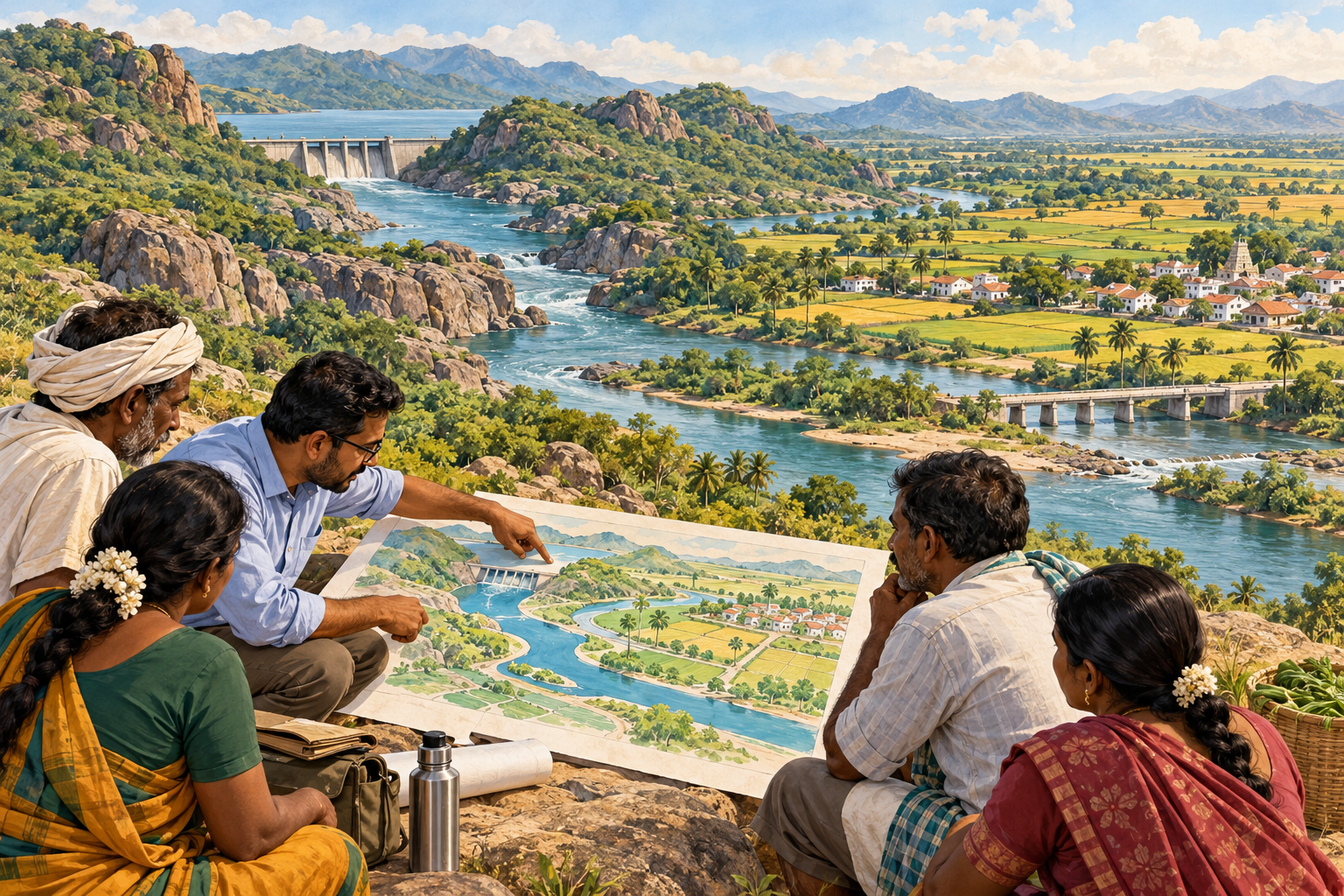
When heavy rain sends large volumes of Cauvery water downstream, a reasonable question follows: could some of that water be stored for the next dry season? For families waiting for drinking water and farmers worrying about a crop, arguments between states can feel distant from the problem.
Mekedatu deserves a serious examination of benefits, risks and enforceable safeguards. But the case for it becomes weaker when it rests on claims that Tamil Nadu has no storage, that all water reaching the sea is wasted or that a new reservoir can guarantee water through any drought. The useful question is how this specific project would change water availability for people across the basin.
What Karnataka has proposed
Mekedatu is a proposed balancing-reservoir and drinking-water project on the Cauvery in Karnataka. An earlier Karnataka project submission hosted by the Central Water Commission described a reservoir capacity of 67.16 TMC and an additional consumptive drinking-water use of 4.75 TMC for the Bengaluru metropolitan region. TMC means one thousand million cubic feet.
These are different quantities: reservoir capacity measures how much can be held, while consumptive use concerns water used and not returned to the river system. The entire reservoir capacity must not be presented as Bengaluru’s annual drinking-water allocation. Those figures describe the earlier proposal, not a verified final approval of the latest version.
A 5 August 2026 explainer reports subsequent revisions. Comparing different versions without identifying their dates can make a public debate misleading.
Does Tamil Nadu have no land for dams?
Tamil Nadu already has substantial reservoirs, including Mettur, Bhavanisagar and Amaravathi, documented in CWC dam-rehabilitation records. Saying it has no storage capacity is incorrect.
That does not prove there are many suitable sites for new large dams. Nor does the existence of hill country in Karnataka prove that every proposed site is feasible. A useful site needs suitable geology, dependable inflow, acceptable submergence, workable costs and the necessary permissions. Existing settlements, forests, farmland and downstream needs all matter.
The claim that Tamil Nadu has no remaining construction sites requires a credible site inventory and feasibility evidence. This research has not established it. Geography should inform the project comparison, not become a shortcut for dismissing a neighbouring state’s concerns.
More storage can reduce risk; it cannot create rainfall
A reservoir can shift water from a wetter period to a drier one if usable inflow is available and the operating rules retain an appropriate reserve. That is a real potential benefit. It is not the same as producing additional water.
Consider a simplified example: a store starts with 100 units, receives 20 and must release or supply 90. It ends with 30 units before other losses. Building space for 200 units would not improve that balance unless enough water arrived to fill it. Actual planning must also account for evaporation, sediment, withdrawals, return flows and the timing of releases.
Test Mekedatu against consecutive dry years, not only a normal year or a spectacular flood. Publish how often drinking-water demand and downstream requirements would be met, and how large the shortfall would be when they are not. Benefits to cultivation should be demonstrated through a basin-wide water balance; the drinking-water proposal is not an unlimited new irrigation entitlement.
Why Tamil Nadu objects—and why that deserves an answer
The Supreme Court’s 13 November 2025 judgment records Tamil Nadu’s argument that another upstream dam could affect flows reaching it. It also records Karnataka’s position that the project would use its allotted share without harming downstream flows. These are the parties’ positions, not two findings that can both be assumed proven.
The practical concern is control and timing. A downstream farmer needs water during the crop’s growing period; receiving an equivalent volume after that period may not repair the loss. An annual total alone is therefore an incomplete answer.
Karnataka’s drinking-water needs deserve serious treatment. So do Tamil Nadu’s concerns about whether promised releases will remain reliable when reservoirs are low. Calling an objection “only politics” does not resolve that question. Politicians in both states should publish the evidence behind their assurances and objections.
Water reaching the sea is not automatically waste
Some floodwater might be usefully captured, subject to safety, downstream needs and available storage space. But a video of a full river does not show what proportion of annual flow is avoidable spill, or how much a reservoir could safely capture.
The lower river and coast also need freshwater. Research in the lower Cauvery basin identifies seawater intrusion among the influences on water quality. Freshwater and saltwater interactions make the river mouth part of the water-management problem, not an irrelevant endpoint.
This draft found no verified basin water budget supporting the claim that “most water goes to the ocean because Tamil Nadu lacks storage”. Assess potential capture with measured seasonal flows, flood peaks, environmental requirements and reservoir operating constraints. Keeping space for flood moderation can also conflict with keeping a reservoir full for the next dry season.
Appraisal permission is not permission to build
In November 2025, the Supreme Court treated the challenge to the preparatory process as premature and described further consideration by the expert authorities. That judgment must not be described as unconditional construction clearance.
Reporting dated 25 May 2026 says the review petition was rejected. A 30 July 2026 report says CWC returned the modified DPR with objections. The original later review order and CWC letter were not independently retrieved for this draft; those developments are attributed to reporting.
Research cutoff: 6 October 2026. No complete set of final project approvals was verified. Before publication, check the latest official appraisal and clearance records; neither a political announcement nor rejection of a particular court application establishes that every required approval exists.
What a credible agreement would need
- A shared water model: publish the inflow assumptions, withdrawals, return flows and drought scenarios, with independent review.
- Clear operating rules: define filling, drawdown, releases and drought procedures consistent with the binding water-sharing framework.
- Visible measurements: publish timestamped storage, inflows, releases and downstream observations, with quality checks and correction history.
- Enforceable oversight: specify who gives directions, who checks compliance and how disputes receive timely resolution.
- Full cost and impact assessment: include forest and wildlife effects, affected communities, rehabilitation, pumping, treatment and long-term operation.
- A fair alternatives comparison: test leakage reduction, wastewater reuse for suitable non-potable uses, existing-storage management, local recharge and demand management alongside additional storage.
These are proposed safeguards, not a claim that a negotiated agreement containing them is already in force. Alternatives should be evaluated honestly too; restoring a tank or saving urban leakage is not automatically enough to meet every future need.
Ask for proof of a shared benefit
Supporting appraisal of Mekedatu and demanding safeguards are compatible positions. If a revised proposal can show dependable drinking-water benefits, compliance with downstream obligations and acceptable impacts compared with alternatives, it deserves consideration on that evidence. If it cannot, the weaknesses should be addressed rather than buried beneath slogans.
The objective should be fewer households facing shortages and more reliable farming decisions across the Cauvery basin. Karnataka and Tamil Nadu should be asked the same question: what measurable, independently checked plan will improve that outcome? The answer needs operating rules and trustworthy data as much as concrete.