

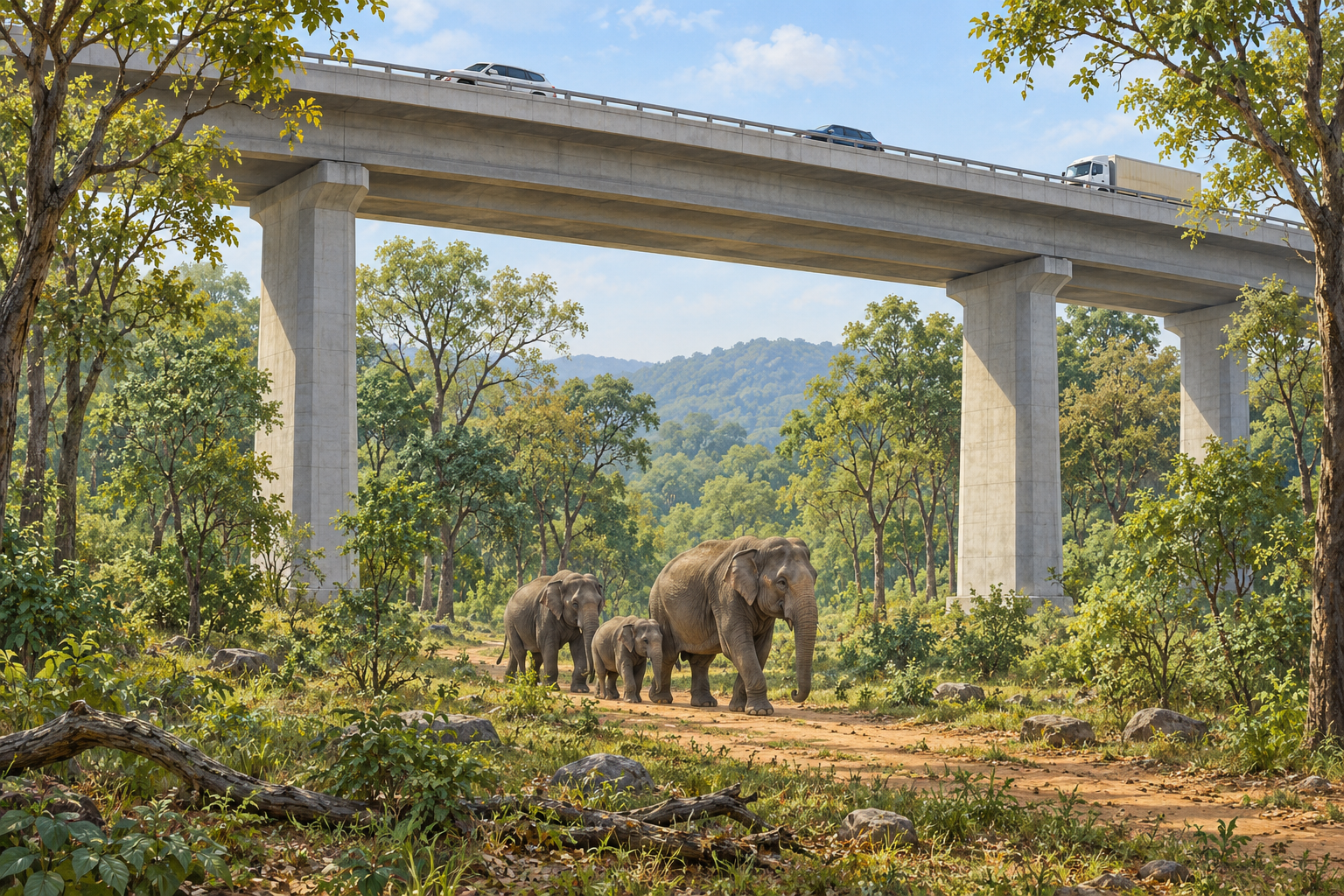
A road through a forest serves people travelling to work, hospitals and family. The same landscape is a route for animals moving between food, water and shelter. Both journeys matter, but a tiger reserve cannot be treated like an empty space waiting for a faster highway.
Could vehicles travel above the forest floor while wildlife moves safely underneath? Purpose-built crossings can help. That does not establish that an elevated highway is the right solution everywhere, or that it justifies removing Bandipur’s night restrictions.
What the Bandipur dispute is about
The WII-hosted tiger-reserve assessment records night closure from 9 pm to 6 am on NH 766 and NH 181 through Bandipur. It also describes Kerala’s repeated demand for relaxation and raises concern about an elevated highway through the reserve.
The interstate disagreement is therefore not simply a choice between progress and obstruction. Travellers and communities need reliable access; conservation authorities must consider disturbance and habitat integrity. A 2026 report about proposed Kerala–Karnataka talks shows the issue remains politically active. Talks or campaign promises are not evidence that a road has reopened.
Status note: sources were reviewed on 6 October 2026. The official assessment is not a live traffic notice. This draft does not establish a new legal order changing the restriction, and it does not provide a current exemption list. Check official travel instructions before a journey; recheck orders before publication if this draft is held.
India already has wildlife-crossing experience
The Pench Tiger Reserve’s official account lists nine NH 44 mitigation structures, completed in 2018 and monitored by the Wildlife Institute of India from March 2019. It reports animal crossings, including tiger use. This is a useful example of monitoring an intervention rather than judging it only from an inauguration photograph.
Three ideas should be distinguished. A wildlife underpass takes animals beneath a road. A wildlife overpass carries habitat above traffic. A long viaduct carries vehicles on an elevated structure and can leave space below. An ordinary urban flyover is not automatically designed to function as a wildlife corridor.
Animals using a structure is encouraging evidence. It does not, by itself, establish that all affected species can move freely, that breeding connectivity is restored or that the surrounding landscape has suffered no loss. Pench is evidence worth studying, not a ready-made approval for Bandipur.
The questions an elevated-road proposal must answer
A site-specific assessment should test whether the structure meets the needs of the species actually using that corridor. What width, height, ground cover and approach conditions are necessary? Where do animals move in different seasons? Will fences guide them to safe crossings or create new barriers?
It should also examine construction access, tree removal, drainage, machinery, night lighting, traffic noise and the risk that the space below becomes parking, storage or a service road. Raising the road deck does not remove the construction footprint. A short elevated section can leave dangerous at-grade gaps at its ends.
These are assessment questions, not engineering dimensions prescribed by this article. The WII guidance on linear infrastructure provides a technical starting point, and the reserve assessment’s objections deserve a documented response. A drawing of elephants under a bridge cannot settle those questions.
Compare alternatives before choosing concrete
| Option | What must be tested |
|---|---|
| Retain night closure and improve travel planning | Reliable daytime services, waiting facilities outside sensitive habitat and clearly communicated rules. |
| Improve routes that avoid the sensitive stretch | Total journey burden, safety, settlement impacts and whether damage is merely shifted to another forest. |
| Add targeted crossings where existing roads interrupt movement | Species-specific location and design, safe approaches, monitoring and maintenance. |
| Consider an elevated alignment | Full construction and operating impacts, alternatives, lawful permissions and long-term cost. |
A tunnel also needs examination of portals, excavation, spoil disposal, drainage and emergency access. Being underground does not make it impact-free. Compare options over their full life, including maintenance and the ecological effects that a construction-price quotation omits.
Human needs must be addressed explicitly
Hospital access, freight schedules and family journeys should be assessed with evidence about who travels, when and why. Where emergency arrangements are legally permitted, publish clear eligibility, contacts and procedures. Do not create informal exceptions that depend on influence.
Consult affected residents, transport workers, forest staff, researchers and communities whose land or livelihoods a diversion would affect. An alternate route that looks simple on a state map can impose a substantial cost on somebody else. Better bus timetables and dependable connections may help sooner than a large civil project, although their usefulness also needs testing.
The strongest approach is evidence-led and reversible
My recommendation is to retain the protection in place while prioritising connectivity improvements that avoid the most sensitive habitat. Study targeted crossings where justified. Consider a larger elevated route only if independent, site-specific evidence shows an acceptable outcome compared with realistic alternatives, and all required permissions are obtained.
Publish the alternatives study, reasons for rejecting routes, cost estimates and monitoring commitments. Define what success means before construction: animal movement, mortality, habitat condition and the burden on travellers. Monitoring should continue across seasons and lead to corrective action if targets are missed.
The question is not whether engineers can build a bridge. It is whether the particular project improves movement for people without making the forest a permanently noisier, smaller or less connected home for wildlife. That requires more than a promise of space underneath.