What should children learn from the armed forces beyond battles, ranks and the occasional patriotic assembly? Cooperation across differences, responsibility for the person beside you and the willingness to serve a common purpose deserve sustained attention.
The proposal here is a dedicated school subject on the armed forces, constitutional citizenship and public service, with its own trained teachers, regular timetable and practical assessment. A few scattered chapters are unlikely to provide the same continuity. But a new subject must earn its place by what students actually learn.
What Sarva Dharma Sthal can teach
A 2020 Indian Express explainer describes Sarva Dharma Sthal as an all-faith place of worship in Army units and explains the role of religious teachers trained in a multi-faith setting. It also describes shared prayer ceremonies. That reporting supports the existence of the tradition; it is not proof that every soldier follows identical practices.
A specific claim that a Muslim soldier sang a Shiva song, or a Hindu soldier joined a particular Muslim prayer, needs an identifiable, verified example. This article does not assign a religion to someone from a video, uniform, name or appearance.
The educational principle is mutual respect: people can protect one another and fulfil shared responsibilities while retaining different beliefs. Respect for a colleague does not require adopting that colleague’s faith. Children with no religious affiliation belong in that lesson too.
Start by recognising what NCC already offers
The CBSE NCC syllabus for Classes XI and XII, 2026–27 already includes national integration, leadership, disaster management, community development and service-specific learning. NCC is not a missing idea that needs to be invented from scratch.
A universal school subject would, however, be a different undertaking. It would need to reach pupils beyond participating NCC arrangements and work for ordinary classrooms with different facilities, abilities and staffing. The proposal should explain how it complements existing learning rather than simply duplicating it.
What a dedicated subject could contain
A possible title is Armed Forces, Citizenship and Service. The following is an editorial curriculum proposal, not an announced government policy:
- Understanding the services: the Army, Navy and Air Force, the distinct role of the Coast Guard, and the difference between military duties and civilian policing.
- Constitution and public duty: equal citizenship, rights, responsibilities, civilian institutions and why lawful disagreement belongs in a democracy.
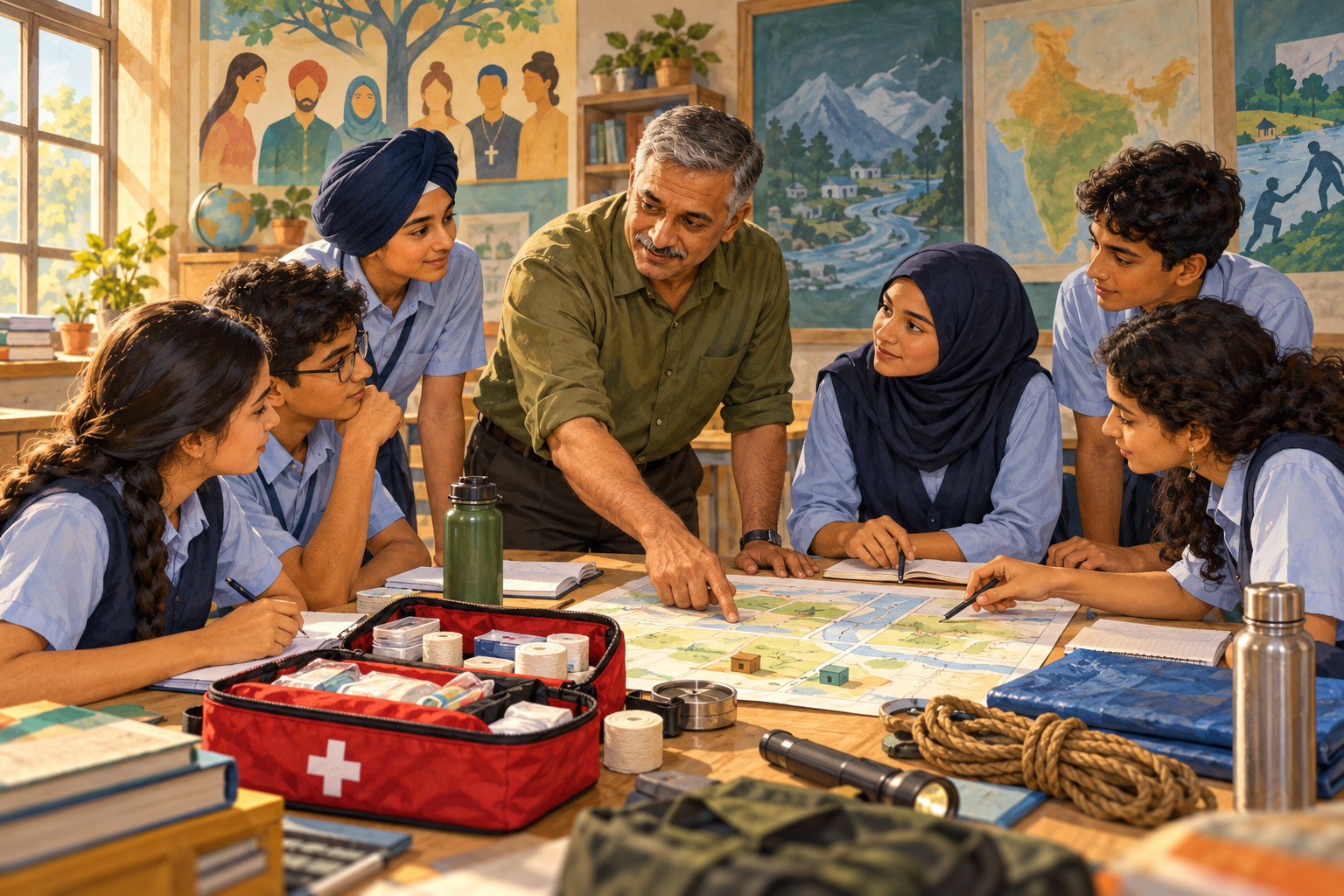
- Cooperation across differences: respectful communication, dealing with prejudice, sharing responsibility and learning about traditions without imposing worship.
- Practical preparedness: age-appropriate first aid taught by qualified instructors, emergency communication, map awareness and safe disaster-response exercises.
- Community service: supervised projects that address a real local need, followed by reflection on what helped and what failed.
- Careers and service life: accurate entry information, technical and support roles, family sacrifices, veterans’ experiences and civilian ways of contributing.
Military history should include decisions, consequences and human costs, using evidence rather than turning every lesson into a celebration of conflict. The purpose is informed respect, not the idea that fighting is the only form of courage.
A teaching pathway for veterans—with teacher training
Retired service personnel could bring valuable experience and gain meaningful employment through such a programme. But service experience alone should not replace the skills needed to teach children.
Create a transparent recruitment route that includes appropriate qualifications, pedagogy, safeguarding, inclusive teaching and supervised classroom practice. Schools could pair trained veterans with experienced educators during an initial period. Teaching posts need stable funding and fair selection, not an assumption that every school can immediately hire one former soldier.
A shared instructor serving a cluster of schools may help a pilot reach rural areas, provided pupils still receive regular lessons. Practising service personnel could contribute authorised guest sessions where feasible; the school system should not assume it can routinely divert them from their duties.
Compulsory learning must respect freedom of belief
There is a difference between requiring pupils to learn about public service and requiring them to join worship. Article 28 of the Constitution regulates religious instruction and participation in certain educational institutions. Among its protections, participation in religious instruction or worship in state-recognised or state-aided institutions cannot be compelled without the relevant consent. Its rules also distinguish institutions wholly maintained by state funds and an endowment or trust exception.
The proposed subject should therefore teach equal dignity and knowledge about traditions through a non-devotional curriculum. It should not grade a child’s religious observance, slogan volume or agreement with a political leader. Nation first should mean service to the constitutional community, including people who disagree with us.
Activities must be accessible to disabled pupils and safe for different ages. This proposal is not compulsory military enlistment or weapons training. A pupil can demonstrate courage by preventing bullying, reporting danger or helping a neighbour; physical drill is not the only measure of contribution.
Make it a real subject, then test whether it works
Give the subject a clear syllabus, protected timetable, trained staff and meaningful assessment. Use practical demonstrations, group tasks, evidence-based discussion and a service portfolio. Reward reliability, care and the ability to explain a decision—not obedience to an arbitrary demand.
Before making it compulsory nationwide, pilot it across different types of schools. Publish the staffing cost, timetable trade-offs, safeguarding experience and independently assessed outcomes. Ask whether pupils can cooperate better, identify misinformation and respond appropriately to an emergency. A new textbook or uniform purchase is not evidence of success.
The strongest version of this idea produces capable citizens, not merely children who can repeat patriotic sentences. A student who respects another person’s beliefs, understands public duty and helps responsibly is already putting the nation’s shared life first.