

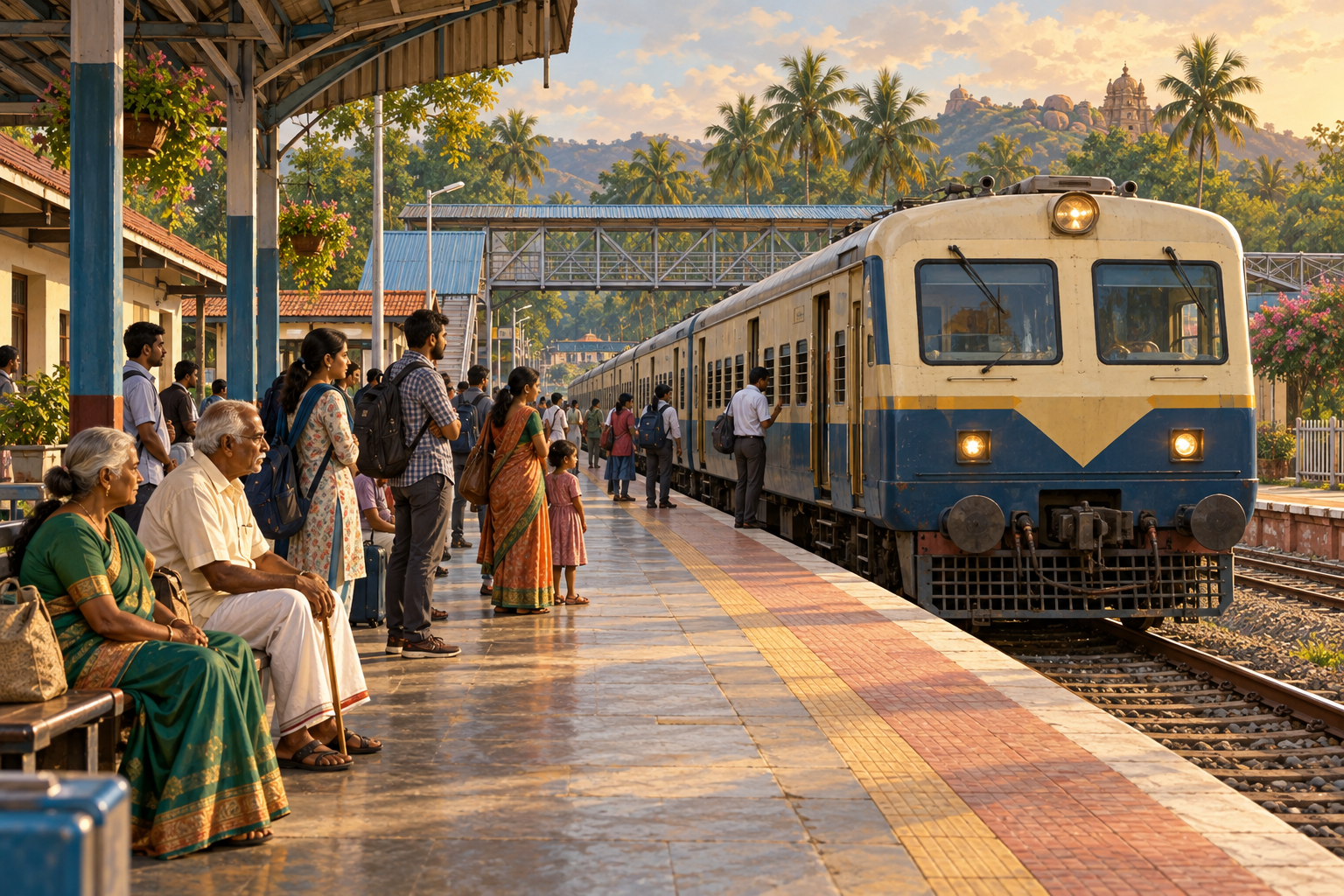
A railway line passing through a village is not the same as a usable railway service. A fast train may pass without stopping, while the local train that serves students, workers and families runs at an inconvenient time—or is unavailable on the day they need it.
Lakshmisha proposes following every express with a passenger or fast-passenger service at a 50 km gap. His underlying demand is strong: smaller stations deserve regular affordable trains, including Sunday journeys back towards Bengaluru. The operating rule needs refinement, but the access problem deserves a measurable response.
What the two train numbers establish—and what remains uncertain
The examples supplied were 66577 and 66505. Published listings identify 66577 as Tumakuru–Shivamogga Town MEMU. However, the listings checked disagree: ixigo lists all seven days, while RailJournal lists Monday to Saturday. Neither is an authoritative live operating order. This article therefore does not assert that 66577 currently runs—or does not run—on Sundays.
For 66505, launch reporting in July 2026 describes Yelahanka–Arsikere MEMU, with 66506 in the return direction, operating six days a week excluding Sunday. That supports the reported launch pattern, not confirmation of every later operating date. A circulated copy of a railway notification was found on a third-party host but not authenticated against an official original.
Direction matters: 66505 is described as travelling away from Bengaluru towards Arsikere; the return-direction service is the relevant check for a Bengaluru-bound journey. Also, 66577’s listed route does not itself terminate in Bengaluru. Connections and the exact boarding station must be considered.
The official NTES service could not be retrieved during this research. Check NTES and station information for the actual journey date, return train, stops and temporary cancellations. A national statement that passenger trains never run on Sundays would be incorrect.
Why 50 km is not the right service guarantee
A physical distance between trains does not tell a passenger when the next train will reach a station. Fifty kilometres corresponds to 30 minutes at 100 km/h and one hour at 50 km/h, before accounting for stops or delays. These are simple illustrations, not operating recommendations.
A Railway Board throughput study explains how headway depends on speed, block-section length and operating time. It is historical technical context, not a current timetable instruction. Safe separation must follow the applicable signalling and operating rules.
An all-stops train also uses track capacity differently from an express. Pairing one with every express could be excessive in some periods and still leave long gaps in others. Freight paths, junctions, overtakes, crew, turnback facilities and maintenance all need planning. A promise based on a distance alone cannot resolve those constraints.
Ask for a published local-service standard
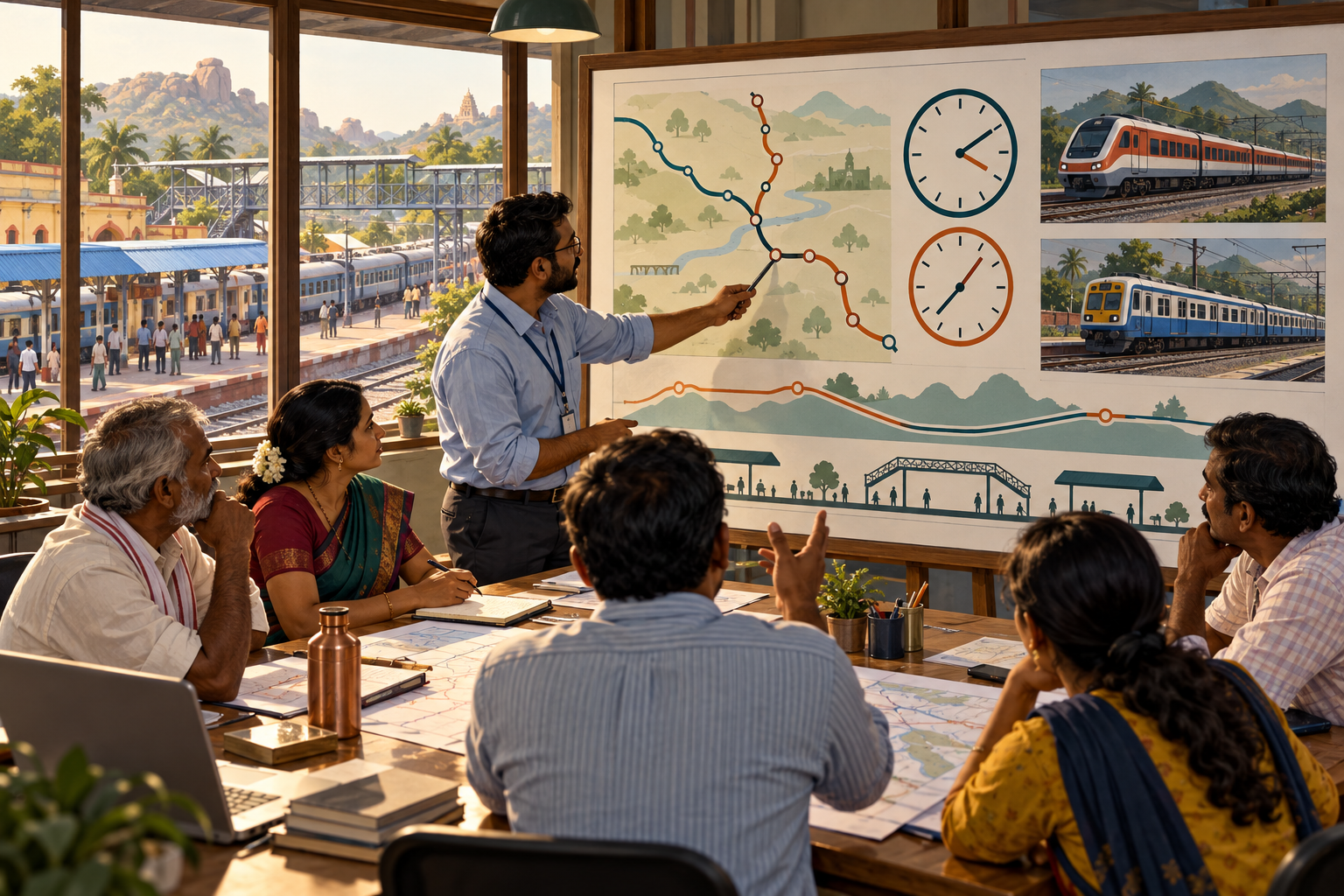
Replace the distance rule with a corridor plan built around passenger needs. Measure the longest gap between useful stopping services, the first and last departure, Sunday availability and reliable connections in both directions.
A proposed pilot might study regular interval services in the busiest periods and dependable midday and evening trains. The actual frequency must follow a demand and capacity assessment; this article does not prescribe an untested interval as a safety standard.
Publish the stations served and the reasons for omissions. A “fast passenger” that skips the very small stations being discussed may not solve their problem. Maintain a balance between useful journey time and access, with feeder connections where a direct stopping service cannot be justified.
Sunday demand should be measured in the return direction
Weekday commuter demand and Sunday return demand can point in different directions and occur at different hours. Count boardings, people unable to board, connection losses and travel alternatives at the relevant stations. Include students, shift workers, traders and families—not only office commuters.
If a Sunday withdrawal is linked to maintenance, examine whether a spare rake, changed maintenance roster, alternate service or coordinated bus connection could meet demand safely. Do not assume the reason without asking the railway. Staff rest and equipment maintenance must remain protected.
A limited Sunday pilot with published costs and ridership could establish whether a permanent service is warranted. Announce changes early and make them visible in Kannada and other appropriate passenger-information languages. A technically available train is not useful if travellers cannot discover when it runs.
Turn a complaint into a service proposal
Collect a short, dated travel diary: station pair, day, desired departure window, available stopping trains, fare alternatives and observed crowding. Do not publish passengers’ faces or personal information without a proper basis. Distinguish missed connections from a train that was never scheduled.
Submit a corridor proposal to the relevant railway division through its published channels and seek an acknowledged response. Use RailMadad for applicable travel-service complaints; it is not a guarantee that a new timetable will be approved. Ask for the operational reason, feasibility assessment and a date for review.
The demand is not that every express must have a shadow train. It is that small-station passengers should have a dependable way to travel, including a sensible Sunday journey home or back to work.